Digital-Marketing
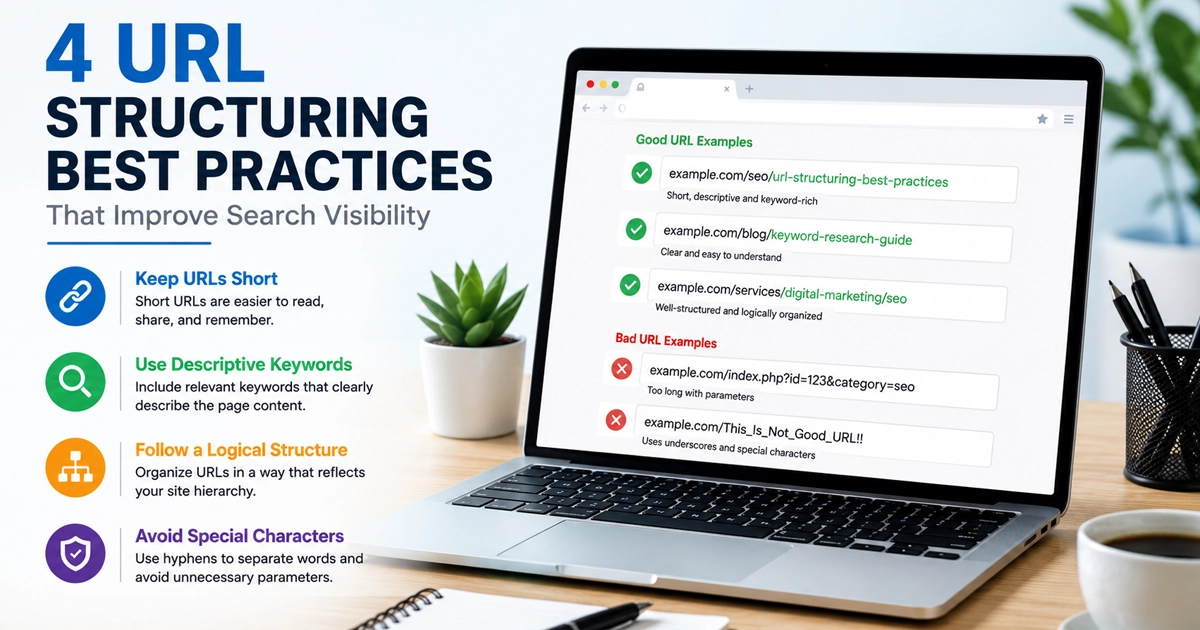
4 URL Structuring Best Practices That Improve Search Visibility
A messy URL structure acts as a roadblock for search engine crawlers and a confusing barrier for human visitors. Many websites grow organically over time, resulting in bloated, disjointed, and inconsistent URL patterns that frustrate search algorithms. If your URLs are long, cryptic, or lack a logical hierarchy, you struggle to communicate the relevance of your content to search engines like Google. We at Mezzex understand that clean URL architecture forms the backbone of a successful search engine optimisation (SEO) strategy. An intuitive, structured URL tells search crawlers exactly what a page contains before they even render the content. This guide details four essential URL structuring best practices that improve your search visibility, boost user experience, and simplify your site hierarchy. Implementing these changes protects your domain authority and helps your content rank higher in competitive search results.
1. Keep URLs Short, Descriptive, and Readable
- Search engines prefer URLs that provide immediate context regarding the destination page.
- Long URLs cluttered with unnecessary parameters, session IDs, or excessive subfolders distract crawlers and dilute the topical focus.
- A concise URL allows users to understand the page topic simply by reading the address bar.
- Include your primary target keyword naturally within the URL string to signal relevance to search algorithms.
- Avoid using generic strings like "page-id=123" or long chains of alphanumeric characters that convey no meaning.
- Focus on readability; human-friendly URLs enjoy higher click-through rates because users trust links that appear relevant and safe.
- Our Mezzex SEO strategies emphasize removing filler words and stop words like "the," "a," or "and" to maintain optimal URL length.
- Short URLs are easier to share on social media platforms, email marketing campaigns, and external blogs, further increasing potential link building opportunities.
- Maintain a consistent length across your entire domain to help search crawlers parse your site structure efficiently.
2. Implement a Logical, Hierarchical Folder Structure
- A logical site hierarchy helps search engines understand the relationship between different pages and categories.
- Organise your content into a parent-child folder structure that mimics a clear, tree-like navigation path.
- Example structures like
[domain.com/category/subcategory/page-title](https://domain.com/category/subcategory/page-title)guide crawlers through your site systematically. - This structure allows search algorithms to identify the topical authority of specific categories before diving into individual posts.
- Avoid nesting content too deeply; pages buried more than four clicks away from the homepage struggle to receive adequate link equity.
- Use your breadcrumb navigation to mirror the URL structure, reinforcing the site hierarchy for both users and search bots.
- A shallow, well-organised hierarchy ensures that every page on your domain remains crawlable and indexable.
- Consistent folder naming conventions make it easier for developers and SEO specialists to manage and scale the website over time.
- Evaluate your folder depth regularly; if a category becomes too large, consider creating sub-categories to maintain clarity.
3. Use Hyphens to Separate Words Consistently
- Google explicitly recommends using hyphens (-) to separate words in a URL string rather than underscores (_).
- Search engine algorithms interpret a hyphen as a word separator, whereas they often treat an underscore as a character that connects words.
- If your URL reads
blue-running-shoes, Google understands this as "blue running shoes." - If you use
blue_running_shoes, the algorithm may see it as one long, indecipherable keyword string. - Consistency is critical; do not mix hyphens and underscores within the same URL or across your entire domain.
- Adopting a site-wide standard for word separation prevents technical indexation errors and helps search crawlers process your content accurately.
- Avoid spaces, special characters, or uppercase letters in your URLs to prevent browser interpretation issues and 404 errors.
- All URLs should be lowercase to maintain uniformity and ensure that search engines treat the link as a single, unique resource.
- Adhering to these standard conventions ensures your site performs consistently across different browsers and server configurations.
4. Eliminate Dynamic Parameters and Session IDs
- Dynamic parameters like
?id=123&session=abccreate massive duplicate content issues for search engines. - These characters make it difficult for crawlers to distinguish between the primary version of a page and various filtered or sorted views.
- If your site generates dynamic URLs for search filters, sorting options, or tracking codes, use canonical tags to point bots to the original page.
- Static, clean URLs are far superior for indexation, as they stay constant regardless of user behaviour or internal link parameters.
- When possible, rewrite dynamic URL patterns into static, human-readable equivalents using server-side configuration rules.
- Monitor your search crawl reports; if you notice a high volume of parameterised URLs, your crawl budget is likely suffering.
- Protect your crawl budget by ensuring that crawlers only focus on the unique, canonical versions of your content.
- Regular audits using site crawling software identify hidden dynamic strings that may be causing indexing bloat.
- Maintaining a clean URL structure without dynamic junk ensures that search engines prioritize your high-value pages.
Partner With Mezzex to Optimise Your Site Architecture
The technical foundation of your website determines your long-term organic success. Poorly structured URLs hinder your crawlability, confuse search bots, and ultimately lower your search rankings. By standardising your URL patterns, implementing a logical hierarchy, and removing unnecessary technical bloat, you unlock the full potential of your site's content. We at Mezzex provide the technical SEO oversight required to audit your domain, fix broken URL structures, and implement best-in-class site architecture. Our digital marketing services focus on results, ensuring your new structure is built to rank. Don't let confusing links hold your performance back any longer. Book our professional SEO services today to secure your digital future and drive sustained growth for your new website. For direct assistance, call our main office at +44 121-6616357 or send a detailed enquiry to [email protected] to start your project.